Cranes and hoists
Tower crane battery power
A tower crane draws a great deal of power for a few seconds at a time and very little in between. That shape is expensive to serve with a generator and well suited to a battery, provided the peaks and the daily energy both fit.
- Peaks are short. Check them against time-limited overload ratings.
- Daily energy is a separate calculation from peak power.
- Starting behaviour and regeneration need an engineering check.
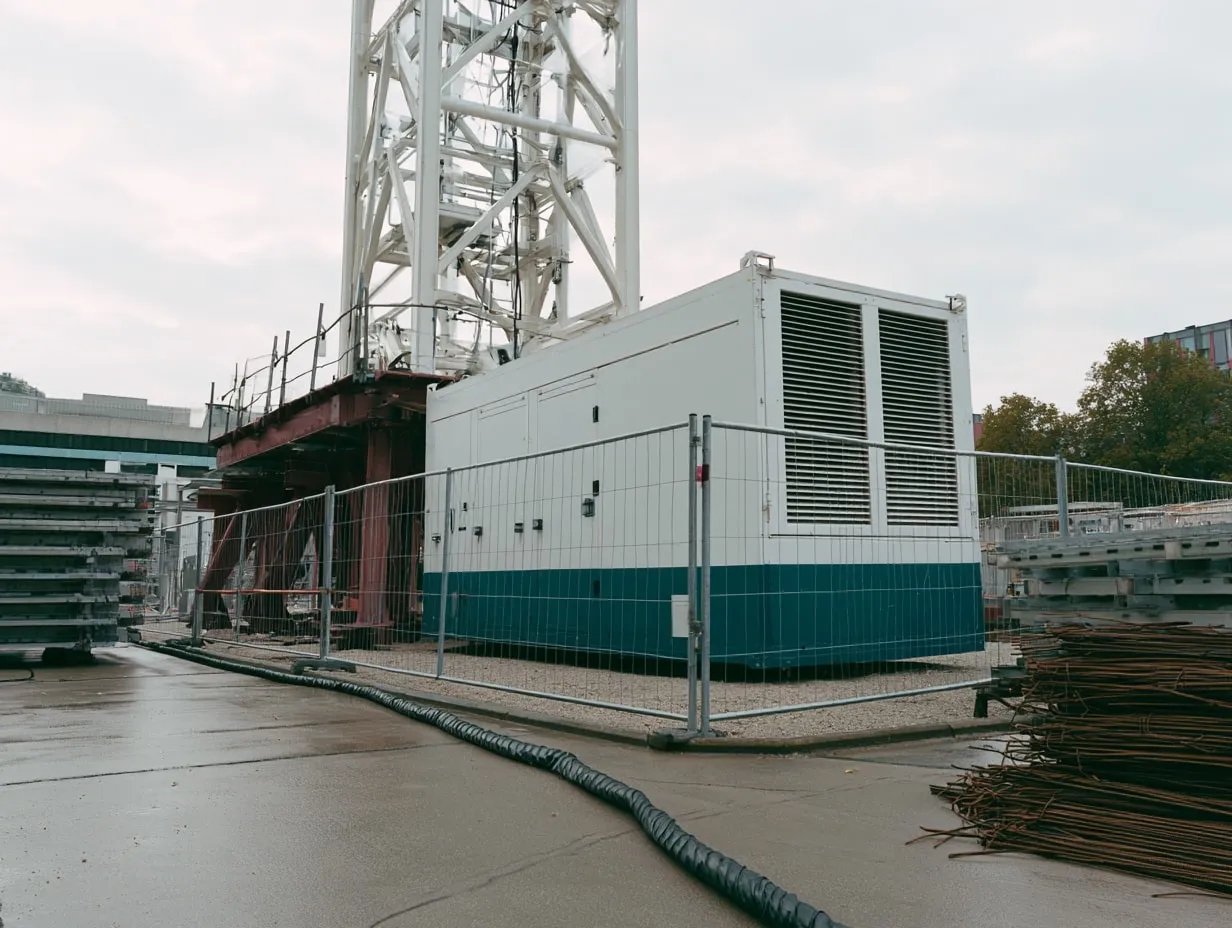
The shape of a crane’s load
Watch a tower crane for ten minutes and you see its electrical load. A hoist motor accelerates a load: demand jumps. The load travels: demand falls. The crane slews, trolleys, waits for the slinger. For much of the hour it draws little more than its controls and cab.
A generator has to be sized for the top of those peaks, including the surge when motors start. It then runs all shift at a small fraction of its rating. That is why cranes are among the clearest cases for a battery: the peaks are high but brief, and the average is low.
Two separate questions
1. Can the system supply the peaks?
This is a power question, in kW and kVA. A battery system has a nominal output it can sustain, and higher overload ratings it can hold for seconds.
| Rating | Ampd 200 | Ampd 400 |
|---|---|---|
| Nominal output | 193 kW / 214 kVA | 386 kW / 428 kVA |
| Longer overload | 233 kW / 248 kVA for up to 60 seconds | 466 kW / 496 kVA for up to 60 seconds |
| Shorter overload | 292 kW / 297 kVA for up to 10 seconds | 585 kW / 595 kVA for up to 10 seconds |
Source: Ampd 200 IEC brochure, Rev 1.3, dated 29 April 2026; Ampd 400 IEC brochure, Rev 1.3, dated 29 April 2026. Manufacturer-published figures for the IEC variant, not independently tested. Specifications can change, so the current data sheet for your territory is confirmed in a project proposal.
A hoist acceleration lasting a few seconds may sit inside an overload rating. A long, heavy lift at full load has to sit inside the nominal rating. The comparison needs the crane’s real demand over time, not its nameplate alone.
2. Is there enough energy for the day?
This is an energy question, in kWh. Add up what the crane uses across the working day, and compare it with what the battery can deliver between charges, plus what the supply puts back while the crane is working.
Rated nominal DC capacity is 215 kWh for the Ampd 200 and 430 kWh for the Ampd 400. Usable energy at the output is lower and is confirmed in assessment. The guide to how long a site battery will run shows the arithmetic.
Because a crane’s average demand is low, a modest charging supply can often keep up. That is what allows a small grid connection, or a much smaller generator, to support a large crane.
What an engineer needs to check
Starting behaviour. How the hoist, slew and trolley motors start, and what current they draw when they do. Cranes with variable-speed drives behave very differently from older direct-on-line or slip-ring machines.
Regeneration. Some crane drives return energy to the supply when lowering a load. Whether that energy can be absorbed, and what happens if it cannot, has to be confirmed for the crane and battery together.
Duty. Lifts per hour, typical and maximum loads, and working hours. A crane on a frame-construction cycle works much harder than one doing occasional lifts.
Other loads on the same supply. Hoists, a second crane, site cabins or lighting all add to the average and may coincide with peaks.
Supply voltage. The reference units are IEC variants for 380 to 415 V three-phase supplies. The crane’s supply requirement must match.
Charging: grid or generator
With a grid connection, the battery charges continuously and discharges on lifts. The connection can be far smaller than the crane’s peak demand, as long as it covers the average. See limited grid site power.
With a generator, the battery lets the engine run for part of the shift at a sensible load instead of idling all day. The brochures list a recommended maximum generator capacity of 350 kVA for the Ampd 200 and 650 kVA for the Ampd 400. Those are maximums, not required sizes. See hybrid generator + battery systems.
Position and access
The unit normally sits at ground level in a service area near the crane base or the main distribution board, clear of the lifting zone. Units weigh up to 5,500 kg and 9,000 kg, so delivery, lifting and ground conditions are planned with the site before the unit arrives.
What to send
- Crane make and model, and motor or drive data if you have it.
- Number of cranes and hoists on the supply.
- The generator currently specified for the crane, and its rating.
- Any grid connection and its capacity.
- Working hours and a rough lifting pattern.
If you only have the crane model and the generator size, that is enough to start a site power assessment.
Product figures on this page: Ampd 200 Brochure IEC Rev 1.3, dated 29 April 2026; Ampd 400 Brochure IEC Rev 1.3, dated 29 April 2026. Manufacturer-published, not independently tested.
Questions buyers ask
Can a battery run a tower crane without a generator?
A battery can supply the crane, but something has to recharge the battery. With a grid connection, even a modest one, a battery can often supply a crane’s peaks without a generator. With no connection, a generator is normally still needed, running for fewer hours to charge the battery.
How do I know if the battery can handle the crane’s starting peak?
By comparing the crane’s peak demand and how long it lasts against the battery system’s overload ratings, which are limited to seconds. That needs the crane’s motor and drive data and is an engineering check. Send the crane make and model and it will be assessed.
Which matters more for a crane, kW or kWh?
Both, and they are separate questions. kW and kVA decide whether the system can supply the lifting peaks. kWh decides whether it can supply a day’s lifting between charges. A system can pass one test and fail the other.
Can one battery supply more than one crane?
It depends on the combined demand, how often lifts coincide, and the charging supply. The manufacturer’s brochures list a configuration of one unit with one generator. Arrangements beyond that need an engineering review for the specific project.